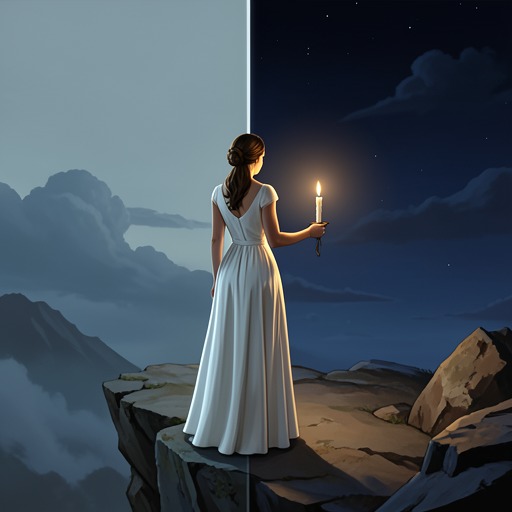
The Veil Between Worlds
Under Your Spell: A Romance Boxed Set of Masked Balls, Haunted Gardens, Magic, and MoreThe Veil Between Worlds is the boundary between the ordinary human world and supernatural realms, and its changing thickness determines how easily those realms can touch. It is not a fixed wall: at particular times and in specially prepared places, it becomes permeable enough for spirits to appear, voices to cross, and dangerous entities to approach. The concept therefore supplies the book’s governing image for supernatural contact while also making that contact conditional, unstable, and hazardous.
Definition and Conditions
The veil covers the whole world, but its permeability varies. On All Hallows’ Eve, it is described as thinnest, creating a temporal opening rather than a permanent collapse between worlds. This thinning coincides with the shattering of Bahor’s spell, and the combination leaves the living world exposed: Bahor knows that the spell has been broken, knows where the vulnerable people are, and understands the weaknesses of the wards protecting them.
The danger is consequently both cosmic and local. Although the veil is planetary in scope, the immediate threat is concentrated in a particular place whose protections can be tested. The warning that the night will require vigilance frames supernatural vulnerability as a condition of boundaries: the world remains inhabited and seemingly ordinary, yet its defenses no longer guarantee separation.
Manifestation and Crossing
The veil’s permeability is dramatized through the appearance of Theodore Sewall before Lavinia Lockett Sewall. After his supposed death, Theodore first exists as a presence in her room, accompanied by calm, brightness, and a glow as though the darkness were lit from beneath by an enormous candle. He then gathers into a visible form, glowing before her. His manifestation turns the veil from an abstract cosmological principle into an intimate threshold through which the dead can return to the room of the living and re-enter a relationship that death appeared to have ended.
Other supernatural encounters present the same threshold in more uncertain spatial terms. Daisy calls into an inky darkness and hears a voice that may come from across the room or from immediately beside her. The voice identifies its speakers as the Oneiroi, making the darkness itself a possible interface between worlds. The scene preserves the instability of the boundary: Daisy cannot establish where the speakers are, only that something beyond her own world has answered.
The veil can also be approached by procedure. In a bookstore, Stella places a large book on a table and draws chalk marks on the scuffed wooden floor between the horror novels and the memoirs. The marks provide instructions for reaching Hell and for understanding what will happen there, at least initially. This ritual arrangement transforms an everyday aisle into a threshold space, showing that supernatural passage depends not only on the condition of the veil but also on knowledge, diagrams, and deliberate preparation.
Spirits and Supernatural Contact
The veil permits more than travel. It enables communication and embodiment, allowing entities to announce themselves or take shape before the living. When Aaron Cavanaugh addresses the mist gathering in the garden, he names Polly Shepps, and the tendrils of mist collect into the ghost’s form. Polly appears in the same housedress, with the same pale marcelled hair, although the newly symmetrical framing of her face marks the manifestation as a significant change from her earlier appearance.
This episode presents the boundary as a medium through which identity can be recovered and inspected. Aaron’s controlled attention gives the encounter a deliberate, almost procedural quality, while the mist’s movement supplies its supernatural force. The ghost is neither simply absent nor wholly restored to ordinary life; she is a presence assembled at the edge between material visibility and immaterial existence.
Narrative Function and Significance
The Veil Between Worlds organizes the book’s tension between skepticism and supernatural certainty. Characters repeatedly encounter phenomena that begin in uncertainty—a presence, a voice, mist, or an unexplained glow—before the narrative grants those phenomena a supernatural form. The boundary thus creates suspense through delayed recognition: the reader and the characters must determine whether an intrusion has actually crossed over, where it is located, and what rules govern its appearance.
Its thinning on All Hallows’ Eve gives the supernatural plot a sacred and dangerous calendar. A date that might otherwise belong to communal custom becomes a moment when ordinary spatial and legal protections are weakened. The resulting threshold is not liberating for everyone; it is an opening that can enable reunion, summoning, or communication, but also gives Bahor an opportunity to attack. The veil’s central significance lies in this double function. It makes love, memory, and release from death conceivable, while ensuring that every opening between worlds carries the possibility of invasion.